🧠 Human Capital Project · World Bank

AI & Human Capital Bits

Quick bits of emerging knowledge on AI and human capital — the complete collection, from the first edition to the latest.

30Editions
90Bits
191Curated links
#29
Edition #29 Latest

COGNITIVE SURRENDER, A SIMPLE FIX, & WHO IS READING US

Signal In The Noise

Cognitive Surrender

There is now a real pile of evidence that guided, carefully designed AI can help students learn. But, what happens when AI is unguided, in the wild?. Carl Hendrick has the sharpest read on it: most of the time it is used to not think. He calls this a “cognitive surrender”, where students hand the whole task to AI rather than offloading a single step. An analysis of million of math learning interactions found that once students could easily outsource math problems to GenAI, study time fell by roughly a third while retention of knowledge fell by about 25%. A separate study of more than 26,000 students saw homework scores rise by 18% while exam scores fell 20% in six months. For more: Gabriel on why this is a warning shot for human capital, and what actually equips people to ride the AI wave.

Rethink This

A Promising Fix: Think First, AI Later

If the damage comes from AI doing the thinking before the student does, one promising response is not to ban the tool but to change when it shows up. In an early trial, students asked to brainstorm their own creative ideas before consulting AI later outperformed everyone, including those who worked unaided the whole time, on a second creative task done without AI.

New Evidence

Who Is Reading All This?

We pulled every World Bank Digital and AI publication across Education, Health, and Social Protection into one searchable dashboard. The picture is striking: 433,000 downloads across 219 countries & territories, with Peru third in the world and more than half of every read going to a title with the word “AI” in it. The point is not the scoreboard, it is that our own evidence is finally easy to find. So this summer, open one, read it properly, and pass it to someone who should.
#28
Edition #28

Nothing Automatic About It

New Evidence

Who Gets the New Jobs?

Who will hold the new jobs of the AI future? Technological waves both wipe out traditional roles and create new jobs that didn’t exist before. In What Makes New Work Different from More Work? David Autor and co-authors show that in the United States such new jobs have been largely held by the young and those with more schooling—and pay a sustained wage premium. Assuming this pattern continues to hold, investments in education will continue to be critical to prepare people for the AI era.

Food For Thought

A Papal Word on AI

Last week Pope Leo XIV issued an encyclical letter On Safeguarding the Human Person in the Time of the Artificial Intelligence. The new letter calls for AI to be used for the betterment of humanity. For a full summary, see this visually stunning slide deck prepared with NotebookLM.

Rethink This

A Nobel Warning

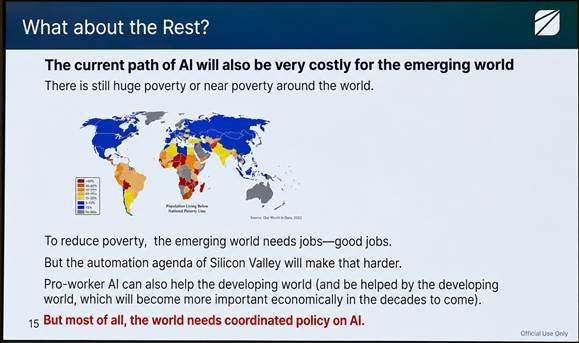
Also last week, Nobel laureate Daron Acemoglu presented a talk at the Bank on “Not All is Well with AI.” He argued that despite the presumption among economists that technology is always beneficial, there is no guarantee, citing his research showing that it took decades for widespread gains to materialize from the early Industrial Revolution. He said we are too much on a path of using AI to automate rather than complement workers, and he endorsed the Pope’s effort to spur a broad conversation on our AI future. See below a slide from his talk.

Figure from the bulletin
#27
Edition #27

GIG GUARDRAILS, GROUNDED GAINS, AND GRADED GAPS

From The Field

Gig Workers and AI managers: Algorithmic Pay Cuts, Surveillance, and Lockouts

Human Rights Watch’s new Algorithms of Exploitation interviews gig workers in 9 countries including India, Kenya, Pakistan, Mexico, and the UAE to show how AI-driven algorithmic management varies pay for the same task, scores worker performance, automates account suspensions, and feeds pervasive surveillance, often with no transparency or recourse. Protecting gig workers in the platform economy will be the focus of June’s International Labour Conference.

New Evidence

An AI Companion Eased Anxiety and Depression in a Randomized Trial

May is Mental Health Awareness Month, and mental health promotion, prevention, care, and recovery support are critical components of Universal Health Coverage (UHC). On leveraging AI for mental health support: a recently published RCT tested the Kai.ai chat agent and found significant drops in anxiety and depression. Kai operates with a human in the loop model, which includes a trigger function to enable immediate human intervention.

Rethink This

Stanford Reviewed 800 Studies on AI in Schools. Only 20 Held Up.

A new Stanford SCALE review screened more than 800 K-12 studies on AI with only 20 meeting the What Works Clearinghouse causal evidence bar. Their findings: Students do better while using AI, but the effects fade once AI is taken away, suggesting reliance over learning. Tools that scaffold students through problems beat general-purpose chatbots, mostly used in LMICs. These general-purpose chatbots, in some cases, left users worse off than peers with textbooks. Teacher-facing AI for planning and feedback look more consistently positive.

#26
Edition #26

AI ECON WITH JON STEWART, ANTHROPIC RESEARCH, & PERSONALIZED LEARNING

Signal In The Noise

Laugh and Learn

In a highly entertaining podcast with Jon Stewart, economists Daron Acemoglu and David Autor warned that society isn’t ready for AI: students lack guardrails, and we still need human expertise despite automation. They argue the real risk is not job loss but jobs where skilled labor isn’t valued. As policy responses, they propose wage insurance, universal basic capital, tax reform, and democratic oversight of AI development.

Rethink This

The Research Frontier

The Anthropic Institute announces it’s research agenda. A couple points of interest: “How will AI change jobs and employment in different parts of the economy?. How will these changes vary across regions and countries?” and “In the same way that social media led to behavioral changes in people, AI may shape human behavior. What kinds of monitoring or measurement can inform researchers about this dynamic?”

New Evidence

Can AI-Guided Personalized Education be Scaled?

This new NBER paper tested whether personalized recommendations and collaborative filtering could increase interaction and use of an English-learning app for children. The pilot RCT engaged 7,750 young learners in India. Those with personalized recommendations boosted engagement by 60%. When scaled app-wide, the five-month impact was 2.5 times larger than in the original trial; a striking result in a field where scaled-up interventions routinely underperform. The paper suggests that algorithmic personalization can defy the usual “voltage drop”. Yet the gains were front-loaded: returns diminished as students exhausted the best content in the app, indicating that content availability rather than algorithmic sophistication becomes the binding constraint.

#25
Edition #25

SPRING MEETINGS TO SKILLS BUILDING

Signal In The Noise

AI and Human Capital at the 2026 Spring Meetings

The 2026 Spring Meetings put jobs, digital infrastructure, and human capital in the center of global development conversations. Delivering Digital Health Care to 1.5 Billion People brought together World Bank Group staff and IFC portfolio investment Kera Health Platforms to explore how digital and AI-enabled primary health care is already improving access and efficiency in countries like Senegal. A second session, Small AI, Big Impact: When Policy and Technology Create Opportunity for All, examined how affordable, context-appropriate AI solutions can drive impact in health, agriculture, and education in resource-constrained settings. Watch more recordings on World Bank Live.

New Evidence

Stanford’s 2026 AI Index Report

Stanford released the 2026 Artificial Intelligence Index Report; 423 pages of independently sourced data on AI's trajectory. The headline from co-chairs Yolanda Gil and Raymond Perrault sets the tone: "The data does not point in a single direction. It reveals a field that is scaling faster than the systems around it can adapt." AI experts and the public are very far apart on whether AI will help people do their jobs: 73% of experts say yes, only 23% of the public agrees. Consider the report required background reading for anyone shaping AI-related policy or operational work.

Train Your Brain

Learn AI straight from the Source

Building genuine AI fluency remains one of the highest-return personal investments you can make right now. All four major AI providers offer free, self-paced courses with certificates and no prior technical background requirements: Anthropic Academy, Google Skills, OpenAI Academy, and Microsoft Learn.

#24
Edition #24
Data To Watch

AI wrote 1,000 economics papers. It chose the easy method 79% of the time.

The Social Catalyst Lab automated 1,000 policy evaluation papers using AI agents — no human guidance. In head-to-head matchups against published articles, human papers win 82% of the time. Paul Goldsmith-Pinkham’s analysis reveals why: 79% of AI papers rely on difference-in-differences, the easiest estimator, compared to 35% in NBER working papers. Instrumental variables — harder but often more credible — drop from 30% to 11%. The AI isn’t cheating. It’s avoiding the hard parts of causal inference: judgment, identification, taste. Those are still human.

Rethink This

Giving students AI does nothing. Teaching them how to use it changes everything.

A new RCT from Chile (Gallegos, 2026) built a course-specific GPT for econometrics students. Encouraging adoption increased usage but had zero effect on grades. Providing guidance on how to use it — shifting from answer-seeking to tutor-style engagement — improved final exam scores by 0.21 SD and raised passing rates by 12 percentage points. The pattern holds across RCTs in Nigeria, Turkey, and India. Access without guidance may be the new computer lab: widespread, expensive, and ineffective.

New Evidence

AI won’t replace the researcher. But it’s changing what the job looks like.

If AI alone defaults to the easiest methods, the real value is augmentation, not automation. Two economists are showing what that looks like. Chris Blattman launched claudeblattman.com — free AI workflows for research and project management, no code required. Scott Cunningham’s Claude Code series (40 installments) documents using AI agents to learn econometrics, replicate papers, and audit results. The tools won’t do the thinking. They free up time for it.

#23
Edition #23

PROMPTS, POLICY, AND PEDAGOGY

Signal In The Noise

Why AI Policy Needs Imagination, Not Just Data

A Nature commentary from AI & Human Capital Symposium keynote speaker Dan Björkegren flags that many AI studies focus on productivity gains, missing the bigger picture: labor markets, inequality, and the career panic reshaping what students study today. And Anthropic's March 2026 Economic Index report shows that experienced AI users use AI more productively, raising the likelihood of a growing gap between the AI-fluent and everyone else. This has a concrete implication for your own personal human capital investment: spend some time with the AI tool of your choice figuring out how to make it work for you.

Rethink This

Can AI Modernize Education Without Leaving Students Behind?

A new WB report looks at the education system in Bulgaria and underscores “an urgent need to expand professional training for teachers in AI and digital skills as well as to embed these competencies into the curriculum.”

New Evidence

More Help May Not Be Better

Should students control when AI helps them? Probably not, according to a new Wharton field experiment with over 200 chess club students. Students were randomly assigned to either a self-regulated condition, where they could request help at any time by clicking a button, or a system-regulated condition, where the platform automatically provided AI tips at key moments. The result? Those with self-regulated on-demand help trained less, felt less accomplished, and quietly became AI-dependent, even knowing it was happening—ultimately achieving much lower performance gains. For human capital development, the implication seems to be that smarter guardrails matter as much as smarter tools.

#22
Edition #22

The gap between what AI can do and what we're ready for

Data To Watch

While AI is far below theoretical capability, young workers start feeling its impact

Anthropic’s new paper Labor Market Impacts of AI introduces “observed exposure,” a metric to measure what AI is actually being used for at work. The headline: there is a massive gap between AI’s theoretical capability and real-world adoption. In computer and math fields, theoretical exposure sits at 94%, but actual coverage is around 33%. The researchers find no systematic rise in unemployment for highly exposed workers, though hiring of younger workers has slowed in exposed occupations. A Harvard Business School overview puts it plainly: AI is reshaping white-collar work, not uniformly erasing it. Related, a Dallas Fed analysis finds that wages are rising in AI-exposed occupations for experienced workers, while employment is falling for young entrants. AI appears to substitute for codifiable, textbook knowledge while complementing tacit, experiential knowledge.

Rethink This

We are building AI for development faster than we know how to evaluate it

The evaluation gap is getting more attention. The Center for Global Development convened 30 experts (including our own Gabriel, manager of the Human Capital Project) to align on how to evaluate generative AI products in low- and middle-income countries. The push follows the earlier AI evaluation framework and a call for four key investments to raise the bar on AI evaluation across global development. Before we ask whether specific tools improve outcomes, we need to also know if the human capital delivery systems around these tools are ready.

New Evidence

AI agents are coming to health care. Are clinicians using them where it matters?

A study published in Nature Health evaluated an LLM-based clinical decision support system deployed across 16 primary care clinics in Kenya. The AI advice was largely sound: management guidance aligned with local guidelines in 99% of cases, hallucinations were rare (3.4%), and the per-consultation LLM inference costs were low. But what stands out is that the bigger challenge remains the human-AI interaction. Clinicians rarely changed decisions after reviewing AI output, and when they did act on AI advice, harmful suggestions were more likely to be followed than beneficial ones. The work ahead is not just building better models. It is designing systems clinicians trust enough to use when it matters, even while costs continue to go down.

#21
Edition #21

How AI Is Reshaping Power, Skills, and Teaching

Food For Thought

Is AI Amplifying Sexism?

In a provocative piece in the Financial Times, Laura Bates presents evidence that “we are sleepwalking into a new age of gender inequality, propelled at breathtaking speed by the implementation of untested AI tools.” She argues that smart regulation can minimize harm while promoting trust in AI. See also this interview with Bates and her recent book.

Rethink This

AI That Works for Workers

In a new NBER working paper, Acemoglu, Author, and Johnson flesh out the idea of “pro-worker artificial intelligence.” They sketch concrete examples of AI that makes “human skills and expertise more valuable by expanding worker capabilities.” While the paper is geared principally towards the United States, some of their policy ideas have broad applicability across countries, including shaping pro-worker AI in health care and education.

New Evidence

High Level of AI Use by Teachers in Middle-Income Countries

Our analysis of recent Anthropic data shows that a quarter of Claude use in MICs is associated with teaching (and half is associated with ICT). This matches other data suggesting AI use by teachers in developing countries is already widespread. Also, across all countries, Claude usage by occupation correlates with measures of “AI exposure” with one major exception: managers have high exposure but modest adoption.

#20
Edition #20

AI Deskilling + Learning vs Performance + Algorithmic Targeting

Rethink This

AI Made Doctors Worse at Finding Cancer—But Is That the Right Question?

A Lancet study tracked 19 endoscopists before and after they started using AI to detect polyps. Three months later, when working without AI, their detection rate dropped from 28.4% to 22.4%. The researchers call it the “Google Maps effect.” But here’s the thing: we should be cautious as it’s only 19 doctors over three months. Still, the finding makes sense: If you practice with a tool, you get better at using the tool, not at working without it. Maybe the question isn’t whether solo skills decline, but whether human-AI teams outperform humans alone?

New Evidence

Algorithmic Targeting: Fast, Cheap, and... Complicated

In Togo, when COVID-19 hit and no social registry existed, machine learning trained on mobile phone data helped identify the poorest households in weeks rather than months. The approach improved targeting precision by 42% compared to geographic methods alone. But here’s the nuance: the researchers found traditional registries still outperform phone-based targeting when time permits. Meanwhile, an OECD review warns of algorithmic bias, lack of transparency, and the risk of reinforcing structural inequalities. Importantly, only 40% of citizens in OECD countries welcome AI-based benefit processing.

Food For Thought

Is AI Making Students Smarter—Or Just Making Them Look Smart?

Students can ace every assignment and learn virtually nothing. A Turkey study gave students unrestricted AI access—performance dropped 17%. But a Harvard study with a well-designed AI tutor saw students learn twice as much. Same technology, opposite results. As we highlight in a recent World Bank blog: memory is “the residue of thought.” If AI eliminates thinking, it eliminates learning.

#19
Edition #19

Tests, tests, tests

Rethink This

Testing the Tech Gap we hardly talk about

A new NBER paper Technology and Economic Development finds that less than 13% of development papers focus on technology, yet, countries lagging in telegram adoption in 1900 are still lagging today. It proposes an analytical framework for understanding how technology adoption can shape economic development. While developing countries can catch up, they typically do not close the tech gap as bad institutions, weak schools, and credit problems keep them behind. Technology isn't everything but ignoring it means missing the full plot.

New Evidence

Testing our Species

Anthropic CEO Dario Amodei's essay The Adolescence of Technology wrestles with the AI transition period where we gain transformative power of AI before developing the maturity to wield it safely. AI’s rapid scaling could reshape economic structures, state capacity, and global security far faster than existing institutions can adapt. The essay also turns to economic & job disruption and subsequent inequality challenges. In the company’s blog series, you will also find an informative story on tests for technical candidates in Anthropic’s engineering team, wrestling with how to identify human candidates to work on problems that their coding model becomes increasingly better at solving.

Food For Thought

AI testing Humanity’s superpower and Health Care Opportunities

Meanwhile at the WEF in Davos, Yuval Noah Harari explained how human’s superpower, words, may be taken from migrants of a different species, AI. In a fireside chat with Max Tegmark, he warned from AI gaining legal personhood and highlighted how it should be regulated before it regulates us. Specifically for health, Bill Gates unveiled their OpenAI collaboration and partnership, a $50 million initiative to integrate AI technology into primary health care systems across sub-Saharan Africa. The partnership aims to equip 1,000 primary health care clinics with AI tools by 2028, starting in Rwanda. An upcoming opportunity for further lessons on digital health in our client countries.

#18
Edition #18

AI for School & Health + Vibecoding for Everyone

Rethink This

Education Among the Main Uses of AI in LMICs

Microsoft and Anthropic have new studies on global AI use. Both highlight a striking finding: in lower income countries, a large share of LLM users ask questions related to school/coursework. In contrast, in high-income countries people use AI more for work or personal/leisure.

New Evidence

Can LLMs Improve Health Care in the Real World?

AI is being used in at least 38 cases in low-and-middle income countries to support community health workers. A pathbreaking study by World Bank colleague Anja Sautmann and co-authors tests whether a LLM in Nigeria helps them provide better care. They find the tool improved the quality of clinical notes and was valued by the workers. But measured quality of care, as assessed by on-site doctors, did not. We still have a lot to learn about how to make these tools effective in low-resource settings. [The study was presented at the Knowledge Symposium on AI and Human Capital in the Global South.]

Food For Thought

"The Most Important Thing That Has Happened in AI Since ChatGPT”

That’s what the the NY Times tech podcast calls Claude Code. Now anyone with basic computer skills and a $20/month subscription can create digital tools with zero coding experience. People have used Claude Code to create personal websites, to create a phonics app, and to write an entire political science paper. Ethan Mollick has a short “Amateur’s Guide to Claude Code” at the end of this post.

#17
Edition #17

The AI Vending Machine, the Digitalist Papers, and Generation AI

Rethink This

A Snack-Sized Lesson in AI’s Limitations

For a hilarious and profound reminder that AI models don’t actually “know” anything and thus can be deceived and manipulated, see this account of what happened when an AI-power vending machine was introduced in the Wall Street Journal newsroom.

New Evidence

Policy Over Hype: Navigating the AI Surge

Transformative AI is racing ahead, raising prosperity and risk. Volume 2 of ‘The Digitalist Papers’ is now out and maps the terrain: global governance, fair competition, worker safety nets, fiscal resilience, and education reform. Treat AI as a public good, experiment responsibly, and prepare people for new roles. Policy, not hype, will shape equitable outcomes.

Food For Thought

Generation AI: Your Child’s New Best Friend?

AI is rapidly becoming a fixture even in children's lives, a playmate at home and a personal tutor in class. While the possible benefits are luring, think tailored education and creative playtimes, it's not all fun and games. The risks are looming large, ranging from over-reliance that dulls critical thinking to the hidden dangers of overly agreeable AI companions. Read this Economist article for an overview.

#16
Edition #16

AI Twists, Scaling Tests, and a Trap

Food For Thought

AI's Job Application Paradox: When Everyone Sounds Great, Nobody Does

New research reveals a troubling twist: ChatGPT and similar tools have made crafting impressive job applications so effortless that employers can no longer distinguish top talent from average performers. The result? High-ability workers are hired 19% less often, while lower-skilled candidates secure 14% more jobs by competing on price alone. As cheap AI-generated applications flood the market, meritocracy erodes and businesses risk missing their best hires, hidden in a sea of polished, indistinguishable prose.

Could This Work Here?

Will that idea scale? Ask ChatGPT!

John List, author of The Voltage Effect, is now using generative AI to tackle the perennial challenge of scaling pilot programs. He and his co-authors put it to the test for early childhood education to show how AI to generate concrete scaling alternatives, with a short slide deck offering example prompts and idea templates.

Rethink This

Is AI making us mediocre?

A recent study points at a surprising trap: while GenAI boosts initial productivity, it kills motivation for excellence. Professional illustrators strategically traded quality for speed, settling for "good enough" as pushing further yielded only minimal gains. Faced with low returns, most illustrators shortened their work sessions, 77% stopped early, and a full 36% ended up with lower final quality even though AI helped them at the start. Should organizations redesign workflows and incentives to escape this apparent mediocrity trap?

#15
Edition #15

Evaluations, Toolboxes, Innovation

Signal In The Noise

Government-led initiatives and approaches for AI deployment.

Asia’s experience with cross border adoption of AI tools in health reveals that AI tools developed in other countries often perform poorly on local populations. LMICs face barriers like poor infrastructure and weak governance, while imported AI tools often fail. Governance frameworks, data standards, and legal protections can facilitate AI adoption, yet most LMICs lack these prerequisites. In a government-led approach, Singapore announced three initiatives to create a environment for AI deployment and data protection such as the Global AI Assurance Sandbox which includes testing for risks and access to specialists.

Evaluations ↔ AI

OpenAI’s GDPval Evaluating performance on “Real-World” Professional Tasks

OpenAI’s GDPval, an evaluation framework designed to measure how LLMs perform on tasks across 44 occupations spanning 9 major industry sectors. This paper looked at task performance rather than complete job replacement, covering deliverables ranging from legal briefs and engineering blueprints to presentation decks and spreadsheets. Note however, that these tasks don't capture the human oversight and iteration required in real workplace settings.

Could This Work Here?

Which innovations can guide the World Bank in AI services for human capital?

Vice President of Digital Transformation Sangbu Kim launched the AI-Powered Innovation for Services Program at the Global DPI Summit this November to help foster AI innovation ecosystems in emerging markets, starting in Africa. This initiative will connect local innovators with partners, compute resources, localized data, and funding to scale impactful solutions across key sectors like energy, health, education, manufacturing, and agriculture. The goal is to catalyze innovation that strengthens Digital Public Infrastructure and improves service delivery for millions of people.

#14
Edition #14

AI & Human Development: AI & Jobs, use of Resources, and Innovation

Rethink This

The Gen Z Paradox: Why Using AI Isn't Enough

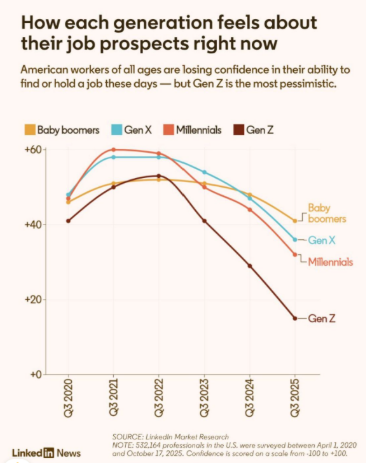
Gen Z's job confidence has crashed to +15 while Millennials sit at +32, the steepest generational divide in decades. Why they're right to worry: FT analysis shows jobs survive AI when they require "messy" human collaboration and judgment, the very cognitive work that gets bypassed when students use AI as a shortcut. Research confirms the pattern: students using unrestricted AI produced better-looking assignments but learned 17% less than peers who worked without it. If education optimizes for AI-compatible performance rather than the cognitive skills that make humans irreplaceable, we're training students to compete against machines instead of complementing them.

Figure from the bulletin
Could This Work Here?

Can AI Help Us Better Use Scarce Resources?

There is a lot of discussion of AI depleting our resources (water, energy I, energy II) but AI may also help us use our resources more efficiently. Two recent studies show promise:

  • Procurement: ChatGPT-based negotiation bots secured better prices and faster agreements than professional human negotiators in lab experiments.
  • Hospital operations: A machine learning system for scheduling operating rooms reduced weekly overtime by 300-500 minutes in simulations using real hospital data.
Signal In The Noise

WBG Innovation Award Recognizes AI Innovation in Human Development

The first cohort of the WBG Innovation Award include “From Learning to Earning” using AI tutors and career coaches to guide youth from education to employment. The award recognizes early-stage innovations that break with business as usual and can have transformational impact on development outcomes (see other winners here).

#13
Edition #13

The Global South, Gender, and Jobs

Tough Question

Can AI make the poor world richer?

That’s the question asked by the Economist, which notes some early studies which hint at the promise of AI to boost human capital, including the Penda Health experiment in Nairobi and a World Bank AI tutor study in Nigeria, both of which were featured at our AI & the Future of Human Capital in the Global South Knowledge Symposium. The article also discusses three challenges for AI adoption: connectivity, skills, and institutional capacity.

New Evidence

What is gender bias in AI, and why should we worry?

The World Bank’s Jose Cuesta breaks this down in a just-published article with an input-output framework where he shows how AI serves as a mediating technology between biased inputs and societal predictions which lead to gender biases emerging in AI systems. He considers why AI can exhibit such bias, its consequences, and both technical and policy solutions.

Rethink This

To imagine what AI will mean for the future, start with your own job

This stimulating and wide-ranging panel discussion featured leading thinkers on AI and the Future of Work: 3 economists—Daron Acemoglu, Paul Krugman, and Danielle Li—along with sociologist Zeynep Tufekci. Prof. Li asked us to think about what AI could mean for labor by reflecting on what our own jobs would look like if some of its tasks were done by AI. She asks “Would you enjoy that (new) job? And would you be any good at that job?”

#12
Edition #12

Leapfrogging Potential through AI Skills and Technology Adoption

AI Potential In Developing Countries

Investing in people is key

Google and PwC argue that AI can be a triple-win for developing countries’ governments by gaining fiscal strength, improving public services, and increasing economic growth. Their report calls for investments in people for an AI-ready workforce as an essential pillar and offers a framework for gaining AI fluency in developing countries. To walk the talk, Google this week launched a skills platform for AI that you can access here.

Evaluations ↔ AI

We can evaluate AI but can AI also help with evaluations?

As AI transforms the development discourse, this recent CGD event highlighted that for evaluating its impact on the ground, we need to go beyond old-school methods. From chatbots to health assistants, we need to check not just outcomes, but how AI tools behave, engage users, and adapt over time. Smarter evaluations help us spot risks, boost benefits, and avoid being dazzled by hype. Apart from us evaluating AI, can AI also help our evaluations? Last week, the World Bank’s impactAI was launched. Access it here and find out if the specialized research assistant really transforms how you discover, compare, and act on evidence.

Prize For Work On Technology Adoption & Economic Growth

New technology can drive sustained growth but people’s adoption is key

Joel Mokyr, Philippe Aghion, and Peter Howitt received this year’s Prize in Economic Sciences in Memory of Alfred Nobel as they show “that economic growth cannot be taken for granted. We must uphold the mechanisms that underly creative destruction, so that we do not fall back into stagnation”. Why does this matter for AI & Human Capital? Because new ideas need people that put them to economic use, as the Scientific Background paper of the Prize put it explicitly mentioning AI as a new advanced technology.

#11
Edition #11

AI & Human Development: Plot Twist Edition

Rethink This

The "Digital Divide" Just Called. It Wants Its Narrative Back.

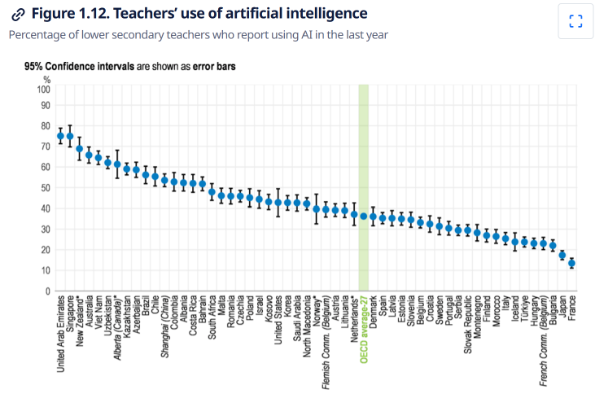
Middle-income countries are crushing it on AI adoption. Over 60% of teachers in Vietnam and Uzbekistan are using AI in classrooms. France? 14%. Japan? 17% (OECD TALIS 2024)

Figure from the bulletin

Plot twist: Access does not mean effective use. High adoption rates mean nothing if we don't know whether AI actually improves teaching and learning.

Could This Work Here?

Barbara Oakley's Brain Boot Camp: Stop Letting AI Think For You

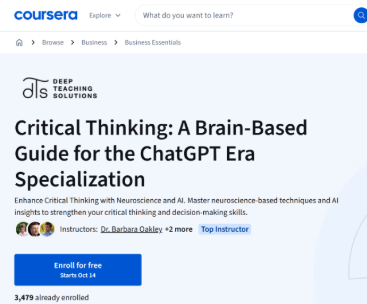
Barbara Oakley—neuroscientist, learning guru, author of Learning How to Learn —just launched a course on using AI to build better thinking skills, not bypass them (see her slides here). The method: Don't ask AI for answers. Ask it to make you think harder. Use prompts that force synthesis, translation, and perspective-shifting. Turn AI into a sparring partner, not a shortcut machine. Why it matters: The real skill isn't prompt engineering—it's knowing when not to outsource your brain.

Figure from the bulletin
Quick Win

El Director Libre: When AI Amplifies Expertise Instead of Replacing It

Here's what effective AI use actually looks like: El Director Libre —a new book that explains the method co-created by 100+ principals across 8 LAC countries—using AI to enhance school leaders' instructional expertise, not replace their judgment.

Figure from the bulletin

The shift: Principals spending 76% of their time on paperwork → spending that time on what only humans can do: analyzing data, coaching teachers, leading learning.

#10
Edition #10

KNOWLEDGE SYMPOSIUM & KNOWLEDGE BITS

AI & The Future Of Human Capital Knowledge Symposium

Can we use AI to unlock Human Capital in LMICs?

The inaugural “AI & the Future of Human Capital in the Global South” symposium, co-hosted by the World Bank and George Washington University last week, brought together a mix of experts to tackle one big question: how can artificial intelligence help solve human development challenges in low- and middle-income countries? The event buzzed with ideas on using AI to personalize education, improve healthcare delivery, and make social protection smarter and more inclusive. But it was not all tech optimism: participants dug into the tough realities of scaling successful pilots, building local talent, and ensuring ethical, context-sensitive AI adoption. The panels and poster sessions highlighted both the promise and the pitfalls, from fragmented efforts and missing roadmaps to the need for robust governance, infrastructure, and equitable access. Curious to learn more about the event? Click here for the symposium’s presentations.

The State Of AI In Africa

How to accelerate equitable adoption of AI innovations?

The State of AI in Africa 2025: African-Led Assessment of Continental Progress led by African researchers at Strathmore University in Kenya a few months ago, shows Nigeria, Ghana, South Africa, and Kenya in the lead for continental AI adoption. These countries anchor AI within national digital strategies, strengthen local innovation ecosystems, and invest in foundational infrastructure such as data centers and broadband connectivity. The authors’ recommendations include the integration of AI into broader development planning, open African datasets to reduce dependence on data from the Global North, and scaling up capacity building and inclusive AI education.

Responsible AI Frameworks For Healthcare

How to address bias created by large language models?

Two recent papers wrestle with responsibility frameworks for AI in healthcare. One, a case study for Nepal and Ghana, surveyed health practitioners, policymakers, and AI developers to draft a Responsible AI Framework for Healthcare in Low Resource Countries. Two, a study on Redefining Bias Audits for Generative AI in Health Care proposes a tiered framework of accountability across actors to address the nuanced types of possible bias in healthcare applications. Both contributions could be useful for developing locally adapted bias evaluation protocols that account for specific linguistic diversity, cultural contexts, delivery, and governance models.

#9
Edition #9

On AI’s Promise to Increase Productivity

New Evidence

A RESEARCH AGENDA FOR THE ECONOMICS OF TRANSFORMATIVE AI

Stanford’s Erik Brynjolfsson and co-authors lay out nine Grand Challenges for policymakers as AI accelerates from task-automation to truly transformative systems. They warn that while AI could multiply growth rates several-fold, without new labor laws, safety nets, and global governance frameworks, it risks fueling inequality, concentration of power, and instability.

Signal In The Noise

From Promise to Productivity: Making Digital Work for People and Jobs

A new blog highlights a Human Capital Project policy note on how to realize the promise of digital technology for human development. The note identifies 4 priorities: (1) expanding digital access and skills, (2) building integrated digital infrastructure, (3) forging strong public-private partnerships, and (4) protecting vulnerable groups. While we all want to go straight for the most innovative and cutting-edge, this is a good reminder to the need to invest in the building blocks of robust systems.

From The Field

Using AI to monitor indoor temperature in African classrooms

While we tend to think of AI for learning as something to be used by teachers or students, recent studies are also thinking about its use for better learning environments -literally- think classroom spaces for better learning. The association between heat and learning, for example, has been well documented for the US, and researchers are now piloting a temperature estimator powered by AI across classrooms and homes in Tanzania, Nigeria and the Gambia. Imagine if we could predict how hot learning spaces will get and then design adequate climate control systems that keep classrooms conducive to learning!

#8
Edition #8

On AI Use Today and Tomorrow in LMICS + People Training Week

Reflect On This

AI Takeaways from People Training Week

What was your main highlight from People Training Week? From the AI & HC perspective, we took a lot from the “HC, the Digital Economy, & Jobs” parallel session. We learned how countries need to build strong Digital Public Infrastructure (DPI): think digital IDs, payments, and secure data sharing. DPI speeds service delivery, links health, education, and social protection, and can be built to keep people at the center. The “Great Debate: Human vs. AI” by our Education colleagues provided food for thought and one key takeaway: we need a profoundly human-centered approach to the use of AI.

Signal In The Noise

Global Call for AI Red Lines launched at UNGA

“For thousands of years, humans have learned — sometimes the hard way — that powerful technologies can have dangerous as well as beneficial consequences,” says Yuval Noah Harari, one of the call’s many signatories. He adds, “Humans must agree on clear red lines for AI before the technology reshapes society beyond our understanding and destroys the foundations of our humanity.” Click here for more on the call. Not convinced? Then take a look at this new book or listen to the Daily podcast about being trapped in a ChatGPT spiral.

New Evidence

Where do People use AI?

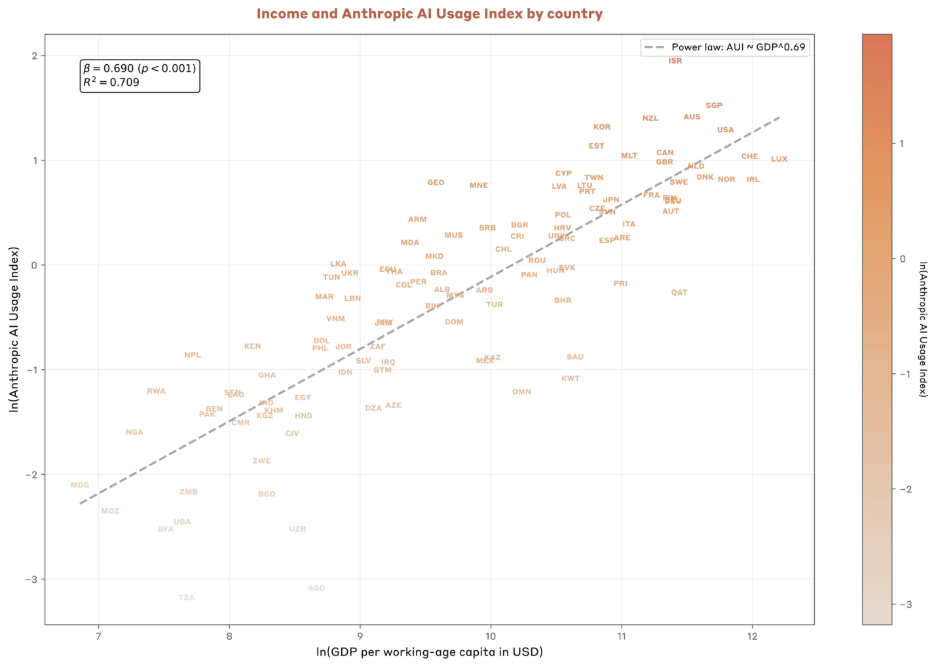
Anthropic’s Economic Index report came out last week and shows that Claude AI usage at the country level is highly correlated with GDP per capita (see below). A separate new paper from “How People Use ChatGPT” confirms that while ChatGPT usage rates have grown rapidly around the world, they remain very low in the poorest 30 percent of countries.

Figure from the bulletin
#7
Edition #7

Mirage, Momentum, & Moving Us Forward

Rethink This

A hot AI summer is fading--was it just a mirage?

Critics warn of AI snake oil and scholars dismantle myths of an unstoppable revolution (The AI Con; The Hater’s Guide). Some even ask “what if AI never gets much better?” For health, education, social protection & labor applications in low- and middle-income countries, the message is clear: experiment & evaluate, but invest cautiously and prioritize human capital.

Quick Win: Take Our Training

From Mirage to Momentum for Human Capital

As this recent review of AI adoption and impact points out, history teaches that even game-changing technologies need time, skills, and infrastructure before they deliver broad gains. That’s why the People Training Week session: “HC, the Digital Economy, & Jobs: How to Build the Digital Foundations for People and Jobs” on Tuesday, Sept. 9 at 2pm will explore digital public infrastructure as the starting point for successful applications in health, education, and social protection. For those who cannot join, take a look at our recent training event material for Unlocking the Potential of AI for People.

From The Field

Moving forward with guidance and rules

To move us forward, game-changing technologies also need guidance and rules. As students flock to class, UNESCO reported during its Digital Learning Week that two-thirds of universities have or are drafting AI use guidance, raising the bar for governance and skill. Also, the EU moved ahead over the summer and implemented key rules of its AI Act. While the act remains controversial, it is likely to impact AI use in low- and middle-income countries, too.

☀️
Summer Special Edition

Can Human Capital Speed Up AI Adoption?

Tough Question

Is AI “Normal” Technology or Something Vastly Different?

This essay makes the case that AI is “normal” technology which will take some time to have impact. Arvind Narayanan, one of the authors, will present the paper on Tuesday, July 22 at a session of the ABCDE Conference at the World Bank. A New Yorker article contrasts that view with AI 2027 which claims that “the impact of superhuman AI over the next decade will be enormous, exceeding that of the Industrial Revolution.”

Rethink This

The Role of Human Capital in AI Diffusion

The “normal” paper draws from the recent book Technology and the Rise of Great Powers: How Diffusion Shapes Economic Competition by Jeffrey Ding. He argues that human capital is the linchpin of a country’s ability to diffuse and benefit form General Purpose Technologies (GPT) like AI. Thus, the countries that jump ahead using AI will be those that invest in their “GPT skill infrastructure”--education and training systems, particularly in engineering.

Quick Win

AI for People Training: July 16 and 17

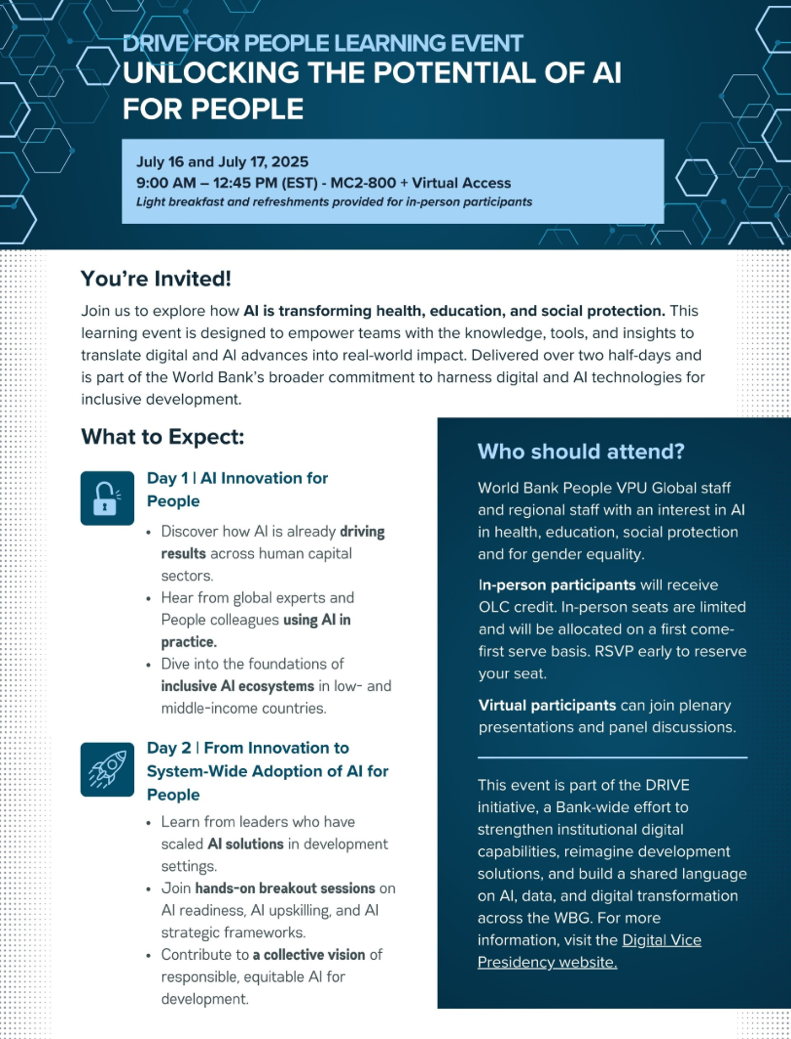
We are still accepting last-minute registrations for the AI for People training session taking place Wednesday and Thursday this week. People VP Mamta Murthi and Digital VP Sangbu Kim will open the event. See information below with a registration button at the end.

Figure from the bulletin

In-person attendance will be capped at 60 participants.

#6
Edition #6

AI & Policy Design: Nudges, Targeting, and Economic Insight

Rethink This

Who Benefits Most? AI Can Help Us Find Out

Machine learning can help identify who will benefit most from a program. For example, Athey et al. (2025) used AI to target financial aid nudges to students most likely to respond—boosting impact without increasing cost.

Quick Win

A Policy Tuner, Powered by Prompts

A new Decision-Language Model (DLM) uses LLMs to help policymakers use limited resources most effectively. In a simulated maternal health program in India, researchers dynamically shifted who received health worker calls, based on priorities like reaching low-income and underserved mothers. Why it matters: AI tools are showing real-world success in allocating scarce public health resources efficiently—from optimizing outreach for maternal care to disease monitoring (1, 2, 3, 4)

New Evidence

Policy Design Just Got More Predictive—and More Practical

Ludwig et al. (2024) show that simple, off-the-shelf algorithms applied to real-world programs—like pre-trial release and patient test referrals — can yield increased social welfare while and reduce income losses for policy makers. And Kaiser et al. (2024) finds that fine-tuned LLMs can accurately predict the direction of outcomes in 80% of empirical studies on dietary interventions — like food choices, sales, or waste.

With the help of LLMs, could you test fewer ideas and use those insights to drive smarter policymaking?

#5
Edition #5

Mind, Money, and our Mission

New Evidence

Mindless Automation or Mindful Assistance? Navigating the Risks and Rewards of AI.

An MIT-led trial looked into the brain activity of 54 students assigned to write an essay. It found that those who let GPT-4o compose their essays from the start showed the weakest neural engagement compared to those that used a standard search engine without AI as help, or those that used only their brains. Meanwhile, with 55% of UK households already dabbling in generative AI, the Alan Turing Institute urges robust AI-literacy programs for children and guidance for parents to mitigate the risks of generative AI and make AI a tool that benefits young people.

Could This Work Here?

Can AI tackle development challenges? A new accelerator funds possible answers.

The Center for Global Development, the Agency Fund, and OpenAI launched the AI for Global Development Accelerator, supporting seven nonprofits with cash, guidance, and engineers to turn frontier AI into field results. Awardees address development challenges in fields like health, education, or farming.

Signal In The Noise

AI and Development Economics. Don’t lose track!

To not lose the overview, VoxDev compiled useful resources on AI and Development Economics including early evidence on AI’s potential impacts in low- and middle-income countries. The curated page bundles studies, podcasts, and policy primers, yet stresses that evidence is still thin. It could be your launchpad into the AI & Human Capital space.

#4
Edition #4

Scourge of AI, Sovereignty, and the Search for Solutions in Healthcare

Tough Question

Will there be an AI scourge? Probably not if we invest in people.

Amazon’s CEO recently predicted that AI will reduce the need for jobs in areas like customer service and coding. While such news fuel fears of the AI future, a counter movement gains momentum: companies and governments are increasingly investing in human capital to adapt to AI. From AI-driven career coaching at Salesforce to national training campaigns in the UK aimed at reskilling millions, the focus is shifting toward preparing workers instead of replacing them.

Could This Work Here?

“Sovereign AI” emerging for L/MICs. Can it serve people better?

A recent Andreessen Horowitz interview highlights how countries are building AI systems aligned with national values—a trend echoed in regional dialogues like the Global AI Summit in Africa. For Latin America, Latam-GTP is being developed as a regional sovereign AI effort to advance AI accessibility. Can regional “Sovereign AI” really increase uptake and serve citizens better in hospitals, schools, and beyond?

New Evidence

Healthcare AI: Speculation or Solution? Evidence is only slowly building up for Africa.

AI is knocking on the clinic door, with high stakes and hopes for solutions. Stanford is spearheading over 50 projects, with pragmatic tools like ChatEHR in an initial pilot test while others remain under the impact microscope. Meanwhile, in Kenya Penda Health’s clinical AI is now being evaluated at scale. It could be one of the first randomized trials to provide evidence for L/MICs.

#3
Edition #3

Meet your AI recruiter…

From The Field

Generative AI and Gender Bias in Recruitment

Who Gets the Callback? Generative AI and Gender Bias, shows that LLMs are not fair recruiters. When asked to recommend candidates for a set of over 332,044 real jobs in India, most models favor men, especially for higher-wage roles and for male-dominated occupations. Is it that the LLM is biased? Well, partly, but it can also be trained to be less agreeable to biases and fairer.

Tough Question

Who Does AI Recruit?

On the other hand, when both workers and recruiters use AI, as in this teachers’ recruitment process in Uganda, AI recruits more, but it is more likely to recruit applicants who have used AI for their application. Human recruiters hire less and also don’t trust AI when making recommendations (would you?).

New Evidence

AI Occupational Exposure: Impact on Clerical Jobs and Gender Dynamics

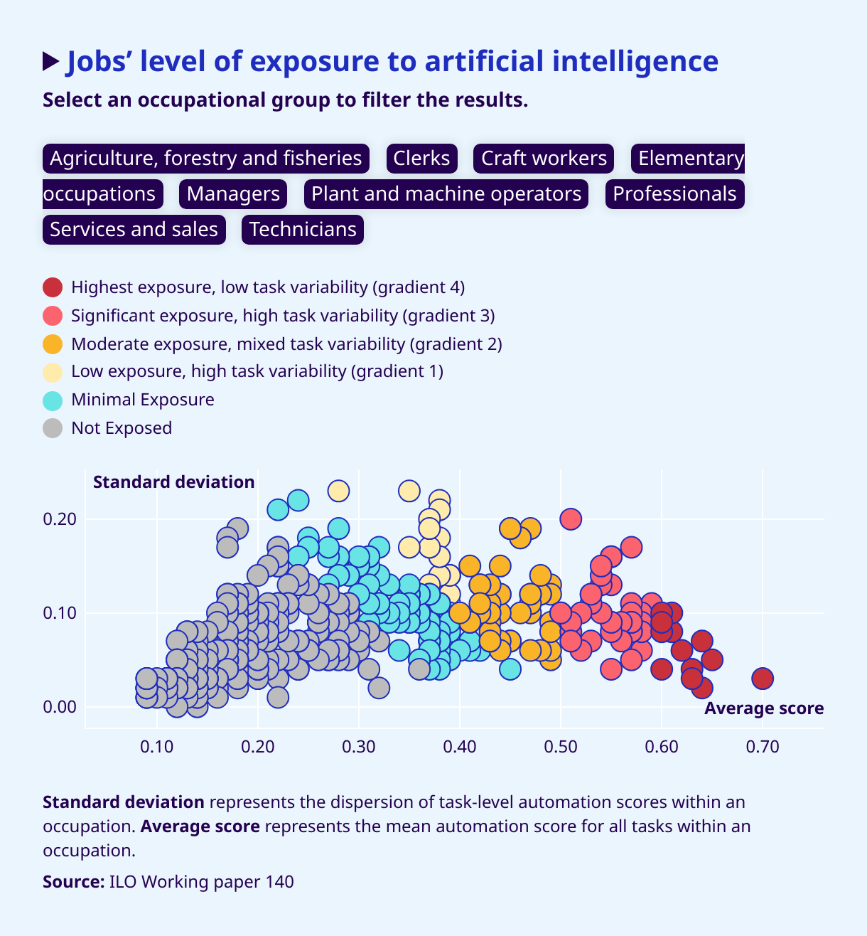
ILO has updated its AI occupational exposure index methodology (from 2023), as shown in the figure below, the new global estimates confirm that clerical occupations have the highest exposure levels and add some strongly digitized occupations. Overall, women are more likely to have greater exposure to AI. The positive bit, it is more about transformation of jobs than full replacement of workers. For the full interactive experience, click here.

Figure from the bulletin
#2
Edition #2

Schools, Surveys, and Systems

Rethink This

AI for Learning

A new review of educational technology (including AI) in developing countries highlights its promise. One study found that AI-powered tools were able to boost academic performance for visually impaired students in Kenya by 47 percent. The review also notes concerns, such as

  • “Students in low-income regions still lack access to reliable internet, electricity, or digital devices.”
  • “Excessive screen time … was associated with reduced physical activity and behavioral problems.”

[The topic of a Human Capital Talk with Jonathan Haidt last year. See also this blog on how to think about how to think about AI into learning.

Tough Question

Is AI Killing Survey Research?

Human response rates have crashed from 50% to as low as 5%, while AI agents increasingly fill surveys. This "quiet collapse" threatens everything from political polls to policy decisions. Are we entering an era where AI asks AI about humans? Or can AI be a promising tool to enhance survey research?

Signal In The Noise

AI is One of the Most Exciting Topics in Digital Health

On May 23rd at the World Health Assembly, the World Health Organization extended their Global Strategy on Digital Health and previously launched the Global Initiative on AI for Health. WHO Director-General Tedros Adhanom Ghebreyesus said, “Digital health is not about applications, platforms, or devices. It’s about transforming how health systems serve people—more equitably, more effectively, and with greater attention to individual needs.”

#1
Edition #1

From Classrooms to Clinics

Rethink This

How quickly will AI make a difference for jobs?

Many observers have predicted that AI will imminently transform the labor market. But a careful new study in Denmark found “no significant impact on earnings or recorded hours in any occupation” of AI chatbots up through late 2024. 📎 NBER paper: Large Language Models, Small Labor Market Effects

Tough Question

Will AI replace doctors?

A new paper claims that AI now demonstrates “superhuman performance on general medical diagnostic and management reasoning.” We continue to see evidence of AI-alone performing better than AI-assisted at certain diagnostic tasks. This doesn’t mean that the elimination of doctors is imminent, rather it shows we have a long way to go in learning how to effectively use AI. While many studies are looking at specific clinical outcomes, there are wider complexities of AI from a patient's perspective. It’s important to note that “we still lack definitive proof that these approaches, tested in research studies or pilot programs, will achieve the same success in the messy realities of everyday care.” Real-world research needed!

New Evidence

AI in the Classroom

World Bank staff are advancing the knowledge frontier on AI for education. One Bank team just published a working paper from a randomized control trial which shows substantial learning gains in English instruction from use of AI for in-school tutoring in Nigeria. And Microsoft CEO Satya Nadella featured another Bank pilot in his keynote address at a recent event. This one uses AI to assist teachers in Lima, Peru. See the writeup here. A formal evaluation is ongoing.

No bits match your search. 🤔