Gabriel Demombynes Economist
Scholar of AI and human capital

Gabriel
Demombynes

Economist. Manager of the Human Capital Project at the World Bank.

Human Capital ProjectWorld Bank Group

Development economist and engineer leading the Human Capital Project. Twenty years across Africa, East Asia, and Latin America, combining operational delivery, policy dialogue, and rigorous evaluation to translate innovation into measurable outcomes in education, health, social protection, and jobs.

Education
Graticule with markers for Bogotá, Manila, Hanoi, Nairobi, and Washington20092020BogotáManilaHanoiNairobiWashingtonG · D
Bogotá · Manila · Hanoi · Nairobi · Washington
Experience
Career timeline, 2003 to presentManager, Human Capital Project, Washington, DC, 2023 to present; Practice Leader for Human Development, Bogotá, 2020 to 2023; Program Leader for Human Development, Manila, 2016 to 2020; Senior Economist, Poverty and Equity, Hanoi, 2013 to 2016; Senior Economist, Poverty Reduction and Economic Management, Nairobi, 2009 to 2013; Visiting Professor, Washington, DC, 2008 to 2008; Economist, Latin America and the Caribbean Poverty Group, Washington, DC, 2005 to 2009; Economic Policy Advisor, Burlington, VT, 2003 to 2004200420062008201020122014201620182020202220242026Washington, DC · Manager, Human Capital Project01 Bogotá · Practice Leader for Human Development02 Manila · Program Leader for Human Development03 Hanoi · Senior Economist, Poverty and Equity04 Nairobi · Senior Economist, PREMWashington, DC · Visiting Professor05 Washington, DC · Economist, LAC Poverty GroupBurlington, VT · Economic Policy Advisor
  • 2023–Manager, Human Capital ProjectWorld Bank · Washington, DC
    • Leads global dialogue, data, and diagnostics for the Human Capital Project across 96 countries.
    • Oversees the $26 million Human Capital Umbrella Trust Fund and the digital and AI agenda for people.
  • 2020–23Practice Leader for Human DevelopmentWorld Bank · Bogotá
    • Led the human development team for Colombia and Venezuela.
    • Directed the Colombia Human Capital Review, the Colombia Systematic Country Diagnostic, and a Development Policy Operation.
    • Coordinated across IBRD and IFC on the vaccine production agenda.
  • 2016–20Program Leader for Human DevelopmentWorld Bank · Manila
    • Led the team covering Brunei, Malaysia, the Philippines, and Thailand.
    • Led the $100 million Philippines COVID-19 Emergency Response Health Project.
    • Guided the team on the Philippines National ID initiative.
  • 2013–16Senior Economist, Poverty and EquityWorld Bank · Hanoi
    • Led the data and statistics program in Vietnam.
    • Led the Vietnam Household Registration System study, the Vietnam 2035 study, and the Vietnam Systematic Country Diagnostic.
  • 2009–13Senior Economist, Poverty Reduction and Economic ManagementWorld Bank · Nairobi
    • Led data and statistics operations in Kenya.
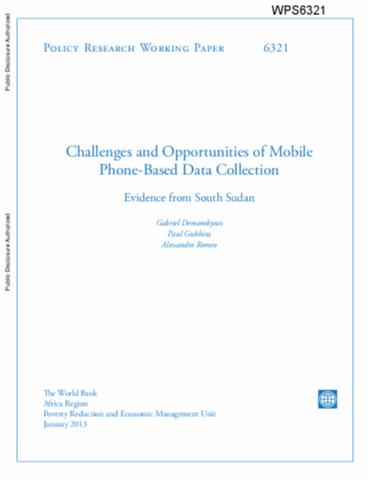
    • Developed innovative phone surveys in South Sudan.
    • Authored evaluation studies cited in The Economist.
  • 2008Visiting ProfessorJohns Hopkins School of Advanced International Studies · Washington, DC
    • Taught economic development to master's degree students.
  • 2005–09Economist, Latin America and the Caribbean Poverty GroupWorld Bank · Washington, DC
    • Led data and statistics programs in multiple countries.
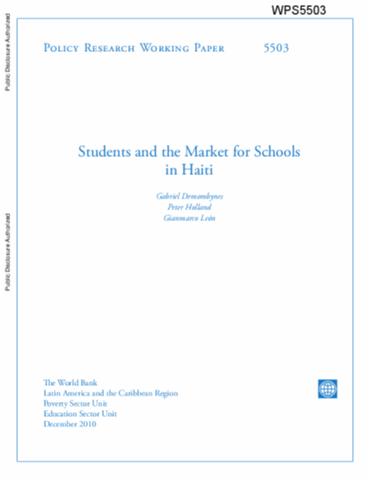
    • Authored analysis of the private sector's role in education in Haiti.
  • 2003–04Economic Policy AdvisorHoward Dean presidential campaign · Burlington, VT
    • Principal advisor to a U.S. presidential candidate; managed economic policy development and coordinated external advisors.
    • Drafted policy statements, briefing materials, policy speeches, and press releases.
  • 1992–96Engineering consultant and internIBM; Institute for Advanced Technology; U.S. Department of Energy · Austin, TX and Rocky Flats, CO
    • Positions with IBM and the Institute for Advanced Technology in Austin, Texas, and the U.S. Department of Energy at Rocky Flats, Colorado.
§ 1Now2023–present

AI and human capital

Illustration from the China Daily op-ed
Op-ed · China Daily
AI augments human capital, and in a variety of tasks, it has proved to be an equalizing force.
China Daily · Opinion · 6 Jan 2024

An op-ed on what AI could mean for learning, health, and social protection in low- and middle-income countries, and why institutions must prioritize adaptability.

Read the op-ed ↗

Since 2023 Gabriel's research and leadership have centered on a single question: what will artificial intelligence mean for people in low- and middle-income countries, for how they learn, stay healthy, and earn a living? The answer so far is more measured than either the boosters or the doomsayers suggest. Exposure to AI rises with education and income, so the first wave of disruption will land in richer countries; in poorer ones, electricity and connectivity remain the binding constraints, while the evidence on AI in classrooms is a warning that tools which substitute for effort can undermine learning.

Figure 1Mean occupational exposure to AI, by country income group
Normalized AI occupational exposure index, 0 to 100
Mean occupational exposure to AI, by country income groupOnly 12 percent of workers in low-income countries and 15 percent in lower-middle-income countries are in high-exposure occupations.Low income37Lower-middle income44Upper-middle income49High income63
Only 12 percent of workers in low-income countries and 15 percent in lower-middle-income countries are in high-exposure occupations.Source: Demombynes, Langbein, and Weber (2025), World Bank Policy Research Working Paper 11057, Figure 2; harmonized labor force surveys for 25 countries.
Figure 2Exposed to AI, but without electricity: workers in low-income countries
Percent of workers in AI-exposed occupations who lack access to electricity
Exposed to AI, but without electricity: workers in low-income countriesFor much of the rural workforce in the poorest countries, the binding constraint on AI is power, not algorithms.Rural workers51Urban workers9
For much of the rural workforce in the poorest countries, the binding constraint on AI is power, not algorithms.Source: Demombynes, Langbein, and Weber (2025), WPS 11057.
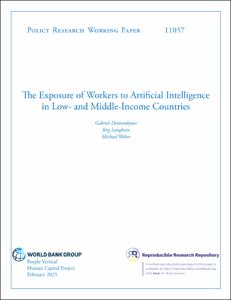
Cover of The Exposure of Workers to Artificial Intelligence in Low- and Middle-Income Countries
The Exposure of Workers to Artificial Intelligence in Low- and Middle-Income Countries
World Bank Policy Research Working Paper 11057 · 2025 · with Jörg Langbein, Michael Weber

Applies an AI occupational exposure measure to harmonized labor force surveys for 25 countries covering 3.5 billion people. Exposure rises with education and urban residence, falls with country income, and is limited by lack of electricity. Cited in the World Development Report 2026.

Writing on AI and human capital
30
AI & Human Capital Bits
The complete archive of the biweekly bulletin for World Bank staff, searchable · gdemombynes.github.io/ai-human-capital-bits
Leading digital and AI at the Human Capital Project

Leadership for global dialogue, data, and diagnostics for solutions and impact. Accountable for the World Bank's global Human Capital Project platform spanning 96 countries, including ministerial engagement, data systems, global knowledge delivery, and oversight of a $26 million Umbrella Trust Fund.

  • 2024Conceived and delivered the Human Capital Conclave with finance ministers from over 30 countries and leading CEOs on Realizing the Potential of Digital Technology and AI.
  • 2024Designed and launched competitive grants to World Bank Group country teams for AI implementation and evaluation in health, education, social protection, and skills for jobs in 18 countries.
  • 2024–Designed the Digital and AI for People Knowledge Series of seminars jointly with the Digital Vice Presidency.
  • 2025Led and organized the inaugural World Bank–George Washington University Knowledge Symposium on AI and the Future of Human Capital in the Global South.
  • 2025Developed the People session at the Global Digital Summit and the DRIVE AI training session for People staff, jointly with the Digital Vice Presidency.
  • 2023–Created the biweekly AI & Human Capital Bits bulletin for World Bank staff; 30 editions are archived online.
Podcasts and media
  • Hello Future podcast artwork
    Can AI End World Poverty?
    HELLO FUTURE with Kevin Cirilli (iHeartPodcasts) · 29 Oct 2025 · 15 min
    Recorded at the 2025 World Bank–IMF Annual Meetings: what the AI revolution looks like for 3.5 billion people in the Global South, from farmers with smartphones to teachers in classrooms without Wi-Fi, and why electricity, not algorithms, may be the biggest barrier.
  • Hello Future podcast artwork
    The Great Divide: Can AI Close (or Widen) the World's Wealth Gap?
    HELLO FUTURE with Kevin Cirilli (iHeartPodcasts) · 3 Nov 2025 · 14 min
    Part two: which jobs are most exposed to AI, why women and urban workers are likely to feel the first wave, and what happens when AI meets energy poverty.
  • Interviewed on AI and development
    The Economist · 2025
Speaking and affiliations
§ 2Places2005–2023

Five places, eighteen years

Gabriel's work has been shaped by where he has lived. Each posting produced a body of research and a set of arguments about what the evidence says. Choose a place on the map or in the list.

World map showing the places where Gabriel Demombynes has workedMarkers for Bogotá, Manila, Hanoi, Nairobi, and Washington, DC, with a dotted outline around Latin America. Each marker links to the corresponding section.200920132020202305 · Latin America1Bogotá2Manila3Hanoi4NairobiWashington (now)
§ 2.1Colombia4.71° N, 74.07° W2020–2023

Colombia · Bogotá

Practice Leader for Human Development

Three years in Bogotá leading the World Bank's human development team for Colombia and Venezuela through the pandemic: a national seroprevalence program, a data dashboard for safe reopening, the vaccine production agenda, the 2022 Systematic Country Diagnostic update, and a new measure of learning poverty at the level of every municipality.

Map showing ColombiaBogotá
Publications
Writing
§ 2.2Philippines14.60° N, 120.98° E2016–2020

Philippines · Manila

Program Leader for Human Development, Brunei, Malaysia, Philippines, and Thailand

Four years in Manila. The work centered on why nearly one Filipino child in three is stunted, on the national ID system, on the 2019 Systematic Country Diagnostic, and, in 2020, on designing and leading the $100 million COVID-19 Emergency Response Health Project that grew into the country's $900 million pandemic and vaccination program.

Map showing PhilippinesManila
Leading the COVID-19 emergency response

The Philippines COVID-19 Emergency Response Project

When the pandemic reached the Philippines in March 2020, Gabriel led the World Bank team that designed and launched the country's emergency health response. As Task Team Leader, with Sutayut Osornprasop, he took a $100 million loan from concept to Board approval on 23 April 2020, in a matter of weeks, under the Bank's global COVID-19 fast-track program, with the Department of Health as implementing agency.

The project's objective was to strengthen the country's capacity to prevent, detect, and respond to COVID-19 and to build lasting public health preparedness: intensive-care and laboratory equipment for hospitals, personal protective equipment, isolation and quarantine facilities, and upgraded national and regional reference laboratories. Additional financing of $500 million in March 2021 and $300 million in December 2021 turned it into the backbone of the national vaccination campaign.

$900M
total World Bank financing, from a $100 million start
33M
vaccine doses procured and deployed nationwide
500
mechanical ventilators, plus 119 portable x-ray machines and 68 ambulances
25×
increase in RT-PCR testing capacity, from 1,000 to about 25,000 tests a day
Sources: World Bank Project Appraisal Document PAD3869 (April 2020); World Bank press releases of 23 April 2020, 11 March 2021, and 21 December 2021; World Bank results brief, 30 May 2022.
Figure 3Stunting among Filipino children under five
Percent of children under five who are stunted
Stunting among Filipino children under fiveRoughly one child in three was stunted for decades, at an estimated cost of about 1.5 percent of GDP a year; the rate has fallen since 2015.0102030402013201520182019202330.333.430.328.823.6
Roughly one child in three was stunted for decades, at an estimated cost of about 1.5 percent of GDP a year; the rate has fallen since 2015.Source: Philippine National Nutrition Surveys (DOST-FNRI), 2013–2023.
Publications
§ 2.3Vietnam21.03° N, 105.85° E2013–2016

Vietnam · Hanoi

Senior Economist, Poverty and Equity

Three years in Hanoi leading the data and statistics program. The centerpiece was the first systematic study of hộ khẩu, Vietnam's household registration system, and its effect on migrants' access to public services, alongside the human development pillar of the Vietnam 2035 report and a survey of quality in district and commune health facilities.

Map showing VietnamHanoi
Publications
Writing
§ 2.4Kenya1.29° S, 36.82° E2009–2013

Kenya · Nairobi

Senior Economist, Poverty Reduction and Economic Management

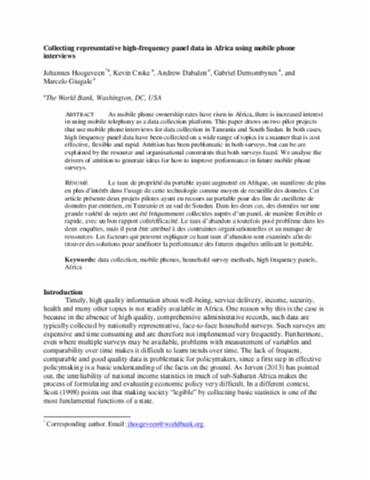
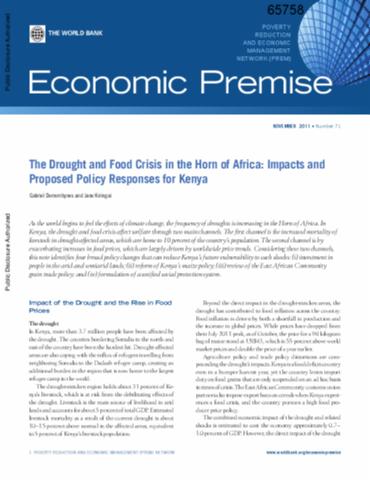
Four years in Nairobi. Research on what drove Kenya's remarkably fast decline in infant mortality, on M-PESA and mobile savings, on the 2011 drought, and on jobs; pioneering high-frequency phone surveys across the border in South Sudan; and, from Nairobi, the evaluation of the Millennium Villages Project.

Map showing KenyaNairobi
Figure 4Infant mortality in Kenya
Deaths per 1,000 live births, five years preceding each survey
Infant mortality in KenyaDeaths per 1,000 live births, five years preceding each survey020406080100199820032008201420227477523932
Source: Kenya Demographic and Health Surveys 1998, 2003, 2008–09, 2014, and 2022. Demombynes and Trommlerová (2016) attribute most of the 2003–08 decline in malaria-endemic zones to insecticide-treated bednets.
Publications
Writing
§ 2.5Latin AmericaRegional2005–2009 and after

Latin America

Economist, Latin America and the Caribbean Poverty Group

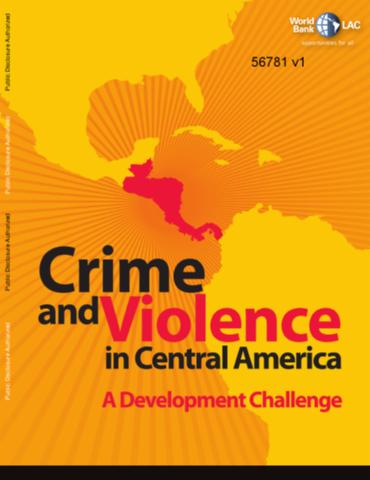
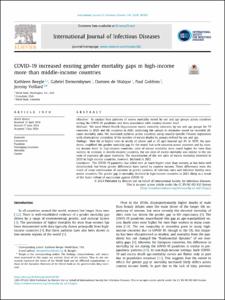
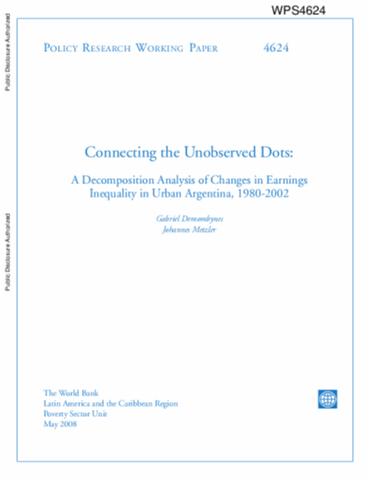
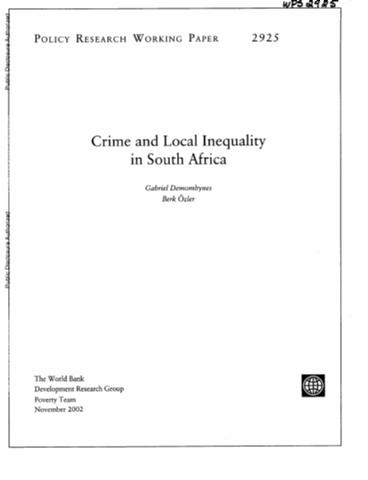
Before Nairobi, four years on the World Bank's Latin America poverty team working on data and statistics across the region: the crime and violence study for Central America, the market for private schools in Haiti, and earnings inequality in Argentina. Later, from Bogotá, comparative work on COVID-19 mortality across countries.

Map showing Latin America
Figure 5Share of 2020 pandemic deaths among people under 65
Percent of deaths
Share of 2020 pandemic deaths among people under 65Age-mortality curves are flatter in lower-income countries, only partly because their populations are younger.02040601111High income4037Upper-middleincome54n/aLower-middleincomeOfficial COVID-19 deathsExcess deaths
Age-mortality curves are flatter in lower-income countries, only partly because their populations are younger.Source: Demombynes, de Walque, Gubbins, Urdinola, and Veillard (2022), BMJ Open; official COVID-19 death counts for 64 countries and excess-death estimates for 41.
Publications
Writing
§ 3Case study2010–2013

The Millennium Villages evaluation

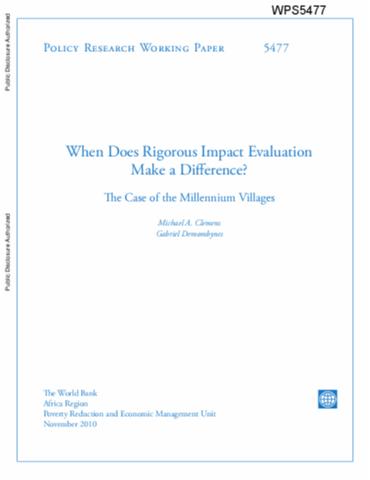
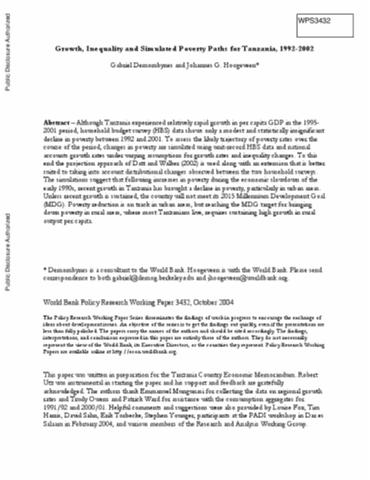
In 2010, Gabriel and Michael Clemens of the Center for Global Development asked a simple question about the Millennium Villages Project, the high-profile package intervention led by Jeffrey Sachs: how would anyone know whether it worked? Comparing trends at the project sites in Kenya, Ghana, and Nigeria with trends in the surrounding regions, they found that the project's before-and-after comparisons attributed to the intervention improvements that were happening everywhere. The exchange that followed, in blogs, seminars, The Guardian, and The Lancet, became a case study in transparency and the scientific method in development.

Figure 6Annual decline in under-five mortality: the Millennium Villages claim and the correction
Percent per year
Annual decline in under-five mortality: the Millennium Villages claim and the correctionThe Lancet paper reported child mortality falling three times faster at MVP sites than in national rural trends. After correcting an error in elapsed time and using contemporaneous comparison data, the sites' decline was slower than the national one.07.82.6As claimed inThe Lancet5.96.4After correctionMillennium Village sitesNational comparison
The Lancet paper reported child mortality falling three times faster at MVP sites than in national rural trends. After correcting an error in elapsed time and using contemporaneous comparison data, the sites' decline was slower than the national one.Source: MVP claim: Pronyk et al., The Lancet (2012). Correction: Demombynes and Prydz, Development Impact blog (10 May 2012), using the elapsed time actually covered and current national DHS trends.
How the debate unfolded
  1. Oct 2010"When Does Rigorous Impact Evaluation Make a Difference?" released as CGD Working Paper 225 and World Bank WPS 5477; first Africa Can post, "Evaluating the Millennium Villages."
  2. Oct 2010Reply to the MVP's response and a seminar with comments from Jeff Sachs.
  3. Jan 2011Shanta Devarajan, World Bank Africa chief economist, calls the paper "the first evaluation of the MVP."
  4. Feb 2011"Millennium Villages Project continues to systematically overstate its effects."
  5. Mar–Jun 2011The Oxford Millennium Villages debate.
  6. Oct 2011"Millennium Villages Project needs proper evaluation," The Guardian, Poverty Matters. Sachs replies in the same forum.
  7. Nov 2011Peer-reviewed version published in the Journal of Development Effectiveness.
  8. May 2012Letter in The Lancet with Jesse Bump and Lawrence Haddad; the MVP corrects its Lancet paper and its lead author departs. A companion post shows under-five mortality fell more slowly at MVP sites than nationally.
  9. 2012Independent critique of the MVP's stunting claims in the American Journal of Clinical Nutrition.
  10. Sep 2013"The New Transparency in Development Economics: Lessons from the Millennium Villages Controversy," CGD Working Paper 342 and World Economics.
  11. 2018–2022The MVP's own retrospective endline evaluation appears in The Lancet Global Health, and a 2021 paper by Mitchell, Gelman, and Sachs sets out to reconcile the competing evaluations.
Papers
Blog posts and commentary, in order
§ 4Publications2002–2025

Papers, books, and reports

32 of 32
§ 5Writing2010–2026

Blog posts, op-eds, and podcasts

45 posts and articles since 2010, on the World Bank's blogs and elsewhere.

East Asia & Pacific on the Rise (World Bank)

Latin America & Caribbean (World Bank)

Podcasts and events

  • Hello Future podcast artwork
    Can AI End World Poverty?
    HELLO FUTURE with Kevin Cirilli (iHeartPodcasts) · 29 Oct 2025 · 15 min
    Recorded at the 2025 World Bank–IMF Annual Meetings: what the AI revolution looks like for 3.5 billion people in the Global South, from farmers with smartphones to teachers in classrooms without Wi-Fi, and why electricity, not algorithms, may be the biggest barrier.
  • Hello Future podcast artwork
    The Great Divide: Can AI Close (or Widen) the World's Wealth Gap?
    HELLO FUTURE with Kevin Cirilli (iHeartPodcasts) · 3 Nov 2025 · 14 min
    Part two: which jobs are most exposed to AI, why women and urban workers are likely to feel the first wave, and what happens when AI meets energy poverty.
  • Interviewed on AI and development
    The Economist · 2025
  • Evaluating AI: What's New and Why the Development Sector Should Care
    Center for Global Development · 14 Oct 2025
    Panel with IDinsight, the Agency Fund, and OpenAI on how to evaluate generative AI tools in developing countries.